EPIC WIN Interview with Andrzej Marczewski
"Gamification: Present and Future" (II)
After a thrilling first part of the interview with Andrzej Marczewski , we keep on talking about the future of gamification, serious games and the likely "bursting bubble" effect.....
Here we go for more Epic knowledge about Gamification!
Now drawing attention
upon serious games and ARGs that are becoming so popular, does the type of
motivation applied change? And what do you think that happens when something is
gamified, and all of a sudden, it stops being like that?
Ok, well. Here we are talking
about two different concepts - serious games and gamification. They are
slightly different.
A serious game has
gameplay and a virtual world (of some kind), gamification does not, it is the
use of game thinking applied to non game “things”. With serious games you are trying to
achieve a goal by getting people engaged in the game. Often the experience is
fun for the user, though not always!
For serious games to work out, they need to actually be
made like normal games. The budget may be smaller, but if you don’t have game
designers working on serious games, they have a real chance of being terrible
and being rejected by the target audience. They are not a small undertaking -
making a good game is really hard, the same can be said for gamified systems!
In addition to this, some of the
motivations for continuing to play a game or use a gamified system are
similar.
When I speak of intrinsic
motivation (Read Andrzej´s blog about it to understand the relationship between pic and text http://marczewski.me.uk/2013/04/06/motivation-lets-get-real-for-a-moment/), I tend to combine the ones used by Deci and Dan Pink. Autonomy,
Mastery, Purpose and Relatedness. All of
these can be found either on their own or in combination in all successful
games AND gamified systems. Without
them, all you are left with is the extrinsic rewards we have spoken about
already. Whilst these can keep you
entertained for a short time, there is no long term future for them in
isolation.
Take FourSquare. The concept was
born from a platform called Dodgeball. This was a location based recommendation
system. You texted where you were and it told you things that other people had
sent to the system about that place.
This was sold to Google who let it die (how unusual for them). However,
the idea was sound and one of the founders released FourSquare. At its heart, it was and is still a
recommendation system. You check in to a location and get to see all sorts of
social information that others have submitted.
The difference was that they gamified it. Checking in, leaving tips and
reviews etc. earned you points and badges.
At the time this was quite new and exciting for many. People loved that
they were ousting others as mayor of a town, the little in built competition of
this and the leaderboards etc. was fun.
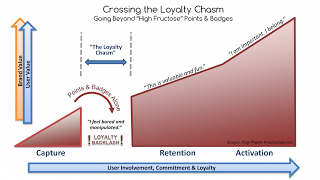
A few years down the line and a
few million users later, this has begun to change. The shiny badges are less
interesting to people, especially long term users. However, the system is still huge - why?
Because, it was built on a much deeper experience, a social experience where
people are able to help and influence others.
This keys are Purpose and relatedness. Some feel that leaving tips has
a purpose (these are philanthropists in my gamification user types), it
helps others. For others, the social aspect is really enjoyable (socialisers).
The points and the badges are
still important, they help people get through the first stages of using the
system. However, FourSqaure have seen the shift in how people want to use the
system and have actually begun to bring the recommendation system to the
forefront over the badges. They are
still there, but they are no longer the focus of the system.
Wow, that’s a big question.
At the moment the gamification bubble is
expanding, but slowing. Gartner themselves have said that by 2014 80% of
gamified projects will fail (http://www.gartner.com/newsroom/id/2251015). That will
be the bubble bursting - that will be the backlash that I mentioned
earlier. (Roller Coaster effect)
People will get tired of everything
they do having leaderboards and points etc - it will no longer have any
impact. This is evolution. Look at how
games have evolved. New mechanics and
ideas are added all of the time, the goal being to engage users with the newest
game. If games never changed, no one
would buy them, otherwise we would all still be playing space war, space
invaders and pong!
Yes, we get stuck sometimes - look at the Call of Duty series.
Whilst there have been changes to the way certain aspects of the game
look and feel, there have been no major core changes to the way it actually
works. You still have to shoot people
and not get shot in return. That is
pretty much the same as Space Invaders or Galaxian!
What is interesting is that
this seems to be reaching a critical mass as well. No longer are Call of Duty games winning big
awards. Look at this year’s BAFTA game
awards and GDC Choice awards. Journey won loads of awards and Call of Duty got
nothing. Why? Because Journey was something new, something no one had
experienced before and players loved it. Sure, Call of Duty made millions and
will keep doing so, but it is interesting to watch it reaching the peak of its
popularity.
The same is true for gamification. The current bread of
mainstream gamification is fast coming to its critical mass. Soon this bubble
will burst. What will be left are the
people who tried to do more than the basics.
They ones who tried to engage users at a core intrinsic level, rather
than just an extrinsic shiny level. Only the ones who did something a little
different will survive. Of course the other stuff will still be around, but
people will be looking for the next big thing in gamification.

So what are your key points Andrzej?
Gamification is powerful, beginning to prove its worth
and here to stay in one form or another.
Anyone who is learning about it needs to look at what is really working,
which projects have had sustained success.
Ignore the projects that say they had a 200% increase in engagement in
the first month of releasing the gamified version of their product. Concentrate
instead on the ones who had a sustained 50% or even 10% increase in engagement
1 year after launch, 2 years after launch and more.
Read about motivation, read Dan Pink , read Deci and
Ryan, read books on gamification and game design. It will all help you to
understand what can be done.
Don’t be blinkered by the definitions of gamification,
even mine! If you are you will miss out on opportunities to create better
experiences for people - pure gamification may not always be the best solution.
Consider serious games, simulations, gameful design etc. Also consider that gamification may not be
the first answer. Bad user experiences are often made worse with gamification,
sometimes you have to fix that first. Gamification is not a plaster for a
broken system. The value proposition of a business keeps on being the most important thing.
Most of all, listen to people and really hear what
they are saying, not what you want to hear.
If they are not getting it - why?
It is easy to say it is because they just don’t understand your
vision. But, is that because you have
visualised and presented your vision poorly, or is your vision even right for
the users you are trying to help?
Because, as Andrzej says... "Content is King, even in Gamification!"
Thanks for an amazing interview Andrzej!! Hope to see you soon here again for more EPIC insights! : )
Sidney Lopez